By Stuart Kurtz, D-ABFT-FT
We have written previously about the nitazene class of synthetic opioids here. Nitazenes were first synthesized in the 1950s and investigated for use in pain management as alternatives to morphine-based opioids. They were never approved for use in humans and are not used in veterinary medicine. Today, they are found in seized drug material, DUID toxicology cases, and postmortem toxicology cases. Nitazenes are potent mu opioid receptor agonists that behave similarly to drugs like fentanyl and its analogs, morphine-based opioids, and orphine analogs. The main concern from their toxicity is respiratory depression which can lead to anoxic brain injury and cardiovascular strain.
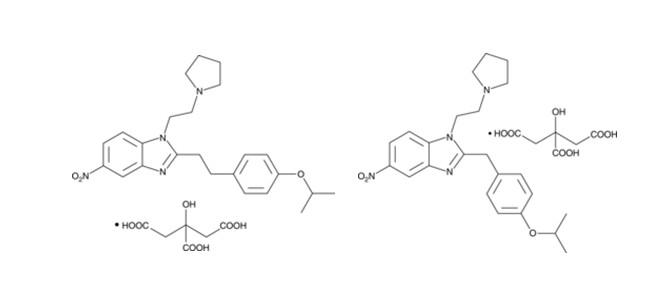
Structures of N-Pyrrolidino Ethylene Isotonitazene(left)1 & N-Pyrrolidino Isotonitazene (right)2 from Cayman Chemical. The citrate molecules are part of the reference material.
N-Pyrrolidino Ethylene Isotonitazene (NPEI) and N-Pyrrolidino Isotonitazene (NPI) are nitazene analogs that have emerged in the past 2 years. The nitazenes emerging in recent years lack any clinical data on potency since they were not pursued for use in humans. The move in the market away from compounds established in the literature has necessitated relying on cell-based studies to evaluate potency. Comparison to known opioids, such as hydromorphone, morphine, and fentanyl, can give us an idea of what concentrations to expect in casework. This is one tool we can use to establish reporting limits in our methods.
In cell-based studies, NPI showed similar potency to isotonitazene. NPI was shown to be more potent than fentanyl and morphine.3 The potency of NPEI is estimated to be in the range of 500-1000x morphine and 75x fentanyl from cell-based models.4 It is one of the most potent nitazenes detected in casework. Similar to other nitazene analogs, lower concentrations can be expected in toxicology testing for NPI and NPEI.
Four case studies were reported by Wood and Moore in April 2026 where NPEI was detected. In two of these cases, the scene investigation found blue/green pills consistent with reports of seized materials containing NPEI. One case did not have any other drugs detected with 41.2 ng/mL NPEI. Two of the cases had other drugs present but were determined to not contribute to toxicity. The quantitative results in those cases for NPEI were 8.5 ng/mL and 1.1 ng/mL. The fourth case had a toxic concentration of tramadol present as well as the designer benzodiazepines bromazolam and desalkylgidazepam.4
Axis Forensic Toxicology screens and confirms NPI and NPEI in the 70510 Comprehensive Panel with Analyte Assurance™ in blood only. Directed tested can be ordered with the 13910: Nitazene Analog panel. As of publishing this blog, we have had one case positive for NPEI which was from Ohio. If you have any questions, please feel free to email us at [email protected] or give us a call at 317-759-4869 option 3.
References
- https://www.caymanchem.com/product/44110/n-pyrrolidino-ethylene-isotonitazene-citrate
- https://www.caymanchem.com/product/34909/n-pyrrolidino-isotonitazene-(citrate)
- De Vrieze, L.M., Walton, S.E., Pottie, E. et al. In vitro structure–activity relationships and forensic case series of emerging 2-benzylbenzimidazole ‘nitazene’ opioids. Arch Toxicol 98, 2999–3018 (2024). https://doi.org/10.1007/s00204-024-03774-7
- Rebecca Wood, Robert Moore, N-pyrrolidino isotonitazene and its metabolites in post-mortem casework, Journal of Analytical Toxicology, Volume 50, Issue 6, June 2026, bkag027, https://doi.org/10.1093/jat/bkag027