In March, Stuart Kurtz presented at the 2026 annual meeting of the Midwest Association of Toxicology and Therapeutic Drug Monitoring (MATT) on kratom products and how they’ve changed over the years. Previous blog posts have discussed mitragynine, kratom case reports, and the emergence of 7-OH mitragynine. Mitragynine pseudoindoxyl is the latest variation to be sold and used by kratom users.
As a quick recap, kratom is a plant that occurs naturally in many parts of Southeast Asia and is commonly consumed by chewing leaves or brewing tea. Mitragynine is the primary alkaloid in the plant material. 7-OH mitragynine (7OH) occurs naturally but at much lower concentrations, and is approximately 10x more potent than mitragynine. It has CNS stimulant effects at lower doses and CNS depressant effects at higher doses. While not regulated at the federal level in the United States, states can decide if they want to regulate sale, possession, and use.
Products containing mitragynine pseudoindoxyl (MPI) have emerged in the past 2 years. MPI is about 10x more potent than 7OH and 100x more potent than mitragynine. MPI is not often found in kratom plant material at detectable levels. In toxicology testing, MPI can be found as a metabolite and breakdown product of the naturally occurring 7OH. Because it’s also a breakdown product of 7OH, products containing 7OH can contain varying amounts of MPI that may not be intended by the manufacturer for consumption by the user.
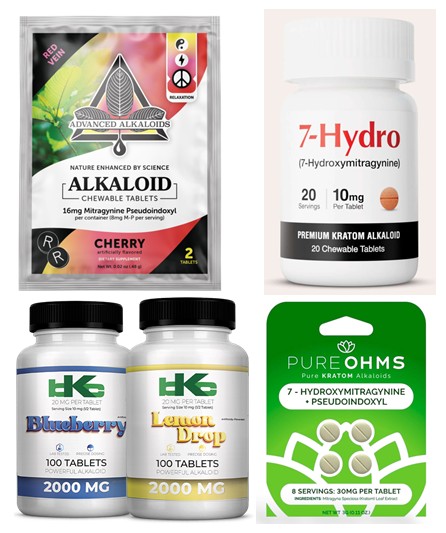
Sellers from left to right, top to bottom: CBD American Shaman, Real Botanicals, Bulk Kratom Capsules (BKC), Pure Leaf Kratom
Products can also be manufactured to intentionally contain MPI in them. These, like 7OH products, are not extracts of kratom plant material. The mitragynine from the kratom plant is extracted and synthetically converted to 7OH and/or MPI. These products may contain much more active components than kratom plant material and, due to lack of regulation, the products may vary in concentration from batch to batch of the same product.
Interpretation of cases containing kratom alkaloids can be tricky. Quantitative data is currently being collected by some labs to help establish expected ratios of mitragynine, 7OH, and MPI in kratom plant material exposure vs. 7OH and MPI product exposure. Toxicology results from 7OH and MPI product exposures might have little or no mitragynine present. Simply screening for mitragynine may result in cases being missed.
7OH is a very small component of the kratom plant material so exposure to it is not likely to have detectable amounts of 7OH or MPI. Large amounts of kratom plant exposure can lead to detectable 7OH and MPI since 7OH is naturally occurring and a metabolite of mitragynine with MPI as a metabolite of 7OH. Relatively low concentrations of mitragynine and the presence of 7OH and/or MPI may indicate exposure to a product that contains 7OH and/or MPI. Scene evidence such as product packets or web browser search history can be helpful in these cases.
Presence of 7OH and/or MPI is notable from a toxicology perspective and inclusion of all known kratom alkaloids in a case on the death certificate can help with public health tracking. It is encouraged to discuss these cases with a toxicologist when they arise to make sure all possibilities are considered. There may be insufficient information available to determine if the exposure was kratom plant material, synthetically converted product, or a combination.
For any questions or assistance with interpretation, please email us at [email protected] or give us a call at 317-759-4869 option 3.
References
- George S Behonick, Christina Vu, Larry Czarnecki, Maisie El-Ters, Kevin G Shanks, Two Single-Drug Fatal Intoxications by Mitragynine, Journal of Analytical Toxicology, Volume 46, Issue 5, June 2022, Pages e110–e114, https://doi.org/10.1093/jat/bkac016
- Sanderson, Mark; Rowe, Adrianna. Kratom. CMAJ Oct2019, 191 (40) E1105; DOI: 10.1503/cmaj. 190470
- Afzal H, Esang M, Rahman S. A Case of Kratom-induced Seizures. Cureus. 2020 Jan 7;12(1):e6588. doi: 10.7759/cureus.6588. PMID: 32051800; PMCID: PMC7001130.
- Krotulski, AJ; Denn, MT; Brower, JO; Papsun, DM; Logan, BK. (2025), Evaluation of Commercially Available Smoke Shop Products Marketed as “7-Hydroxy Mitragynine” & Related Alkaloids, Center for Forensic Science Research and Education, United States.
- Anderer S. What to Know About 7-OH, the New Vape Shop Hazard. JAMA. 2025;334(12):1045–1046. doi:10.1001/jama.2025.13592
- Smith, K.E., Boyer, E.W., Grundmann, O., McCurdy, C.R. and Sharma, A. (2025), The rise of novel, semi-synthetic 7-hydroxymitragynine products. Addiction, 120: 387-388. https://doi.org/10.1111/add.16728
- Pullman MK, Kanumuri SRR, Leon JF, Cutler SJ, McCurdy CR, Sharma A. Cardio-pulmonary arrest in a patient revived with naloxone following reported use of 7-hydroxymitragynine. Clin Toxicol (Phila). 2025 Sep 30:1-2. doi: 10.1080/15563650.2025.2565428. Epub ahead of print. PMID: 41025553.