By Kevin Shanks, D-ABFT-FT
Ayahuasca is a word from the Quechua language which means “vine of the souls”. More commonly ayahuasca is used in reference to a traditional “brew” made from various Central and South American plants including the perennial shrubs Psychotria viridis, Mimosa hostilis, and Peganum harmal, the perennial tree Acacia confusa, and/or the Banisteriopsis caapi vine. This brew is used in various spiritual ceremonies and most often in the ancient healing traditions of shamanism.
So, you might ask yourself, why are we talking about these plants on this blog? To answer that, let’s take a look at chemistry and pharmacology behind them.
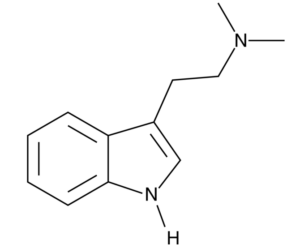
The chemical structure of N,N-dimethyltryptamine. Drawn by Kevin G. Shanks (2023).
P. viridis and the root bark of M. hostilis contain an alkaloid called N,N-Dimethyltryptamine, otherwise known as DMT. From a chemical structure perspective, DMT is very similar to the neurotransmitter serotonin. DMT is considered a psychedelic tryptamine and its mechanism of action is thought to be via partial 5-HT2A (serotonin) receptor agonism, but much is unknown still to this day. In the human body, DMT is readily degraded in the stomach and small intestine by the enzyme monoamine oxidase A (MAO-A). And for this reason, DMT’s effects are highly dependent on dose and route of administration. Use of the substance can range from mild psychedelic experiences to powerful hallucinations. It is important to note that DMT is also a trace endogenous compound in the human body.
Positive user-described effects of DMT include euphoria, hallucinations, and perceptual distortions. Ego softening/loss (loss of all reality) has been described. Feelings of love and empathy, and acceptance have also been documented. Many users have described the drug effects as profoundly life-changing and spiritual. Some have reported understanding his/her ultimate purpose on Earth or the true nature of the universe. Others have used the term spiritual awakening to describe the drug’s effects. Adverse effects include hypertension, tachycardia, nausea, diarrhea, body aches, fear, and paranoia. Vomiting is also an adverse effect, but is sometimes considered to be an essential part of the spiritual experience as it represents the release of negative energy and emotions.
The cover of TiHKAL by the Shulgins.
Alexander and Ann Shulgin devote one chapter to ayahuasca and another chapter to DMT in their book on tryptamines, TiHKAL (Tryptamines I Have Known And Loved), The Continuation. As with their other book, PiHKAL, we highly recommend TiHKAL as a source of information on psychedelic and hallucinogenic tryptamines.
Some user reports from TiHKAL regarding the effects of DMT are:
“20 mg intramuscularly: I begin to see patterns on the wall that were continuously moving. They were transparent, and were not colored. After a short period these patterns became the heads of animals, a fox, a snake, a dragon. Then kaleidoscopic images appeared to me in my inner eye, fantastically beautiful and colored.”
“50 mg intramuscularly: I feel strange, everything is blurry. I want my mother, I am afraid of fainting, I can’t breathe.”
“60 mg intramuscularly: I don’t like this feeling – I am not myself. I saw such strange dreams a while ago. Strange creatures, dwarfs or something; they were black and moved about. Now I feel as if I am not alive. My left hand is numb. As if my heart would not beat, as if I had no body, no nothing. All I feel are my left hand and stomach. I don’t like to be without thoughts.”
“60 mg smoked: Slightly threatening patterns – no insight – slight sense of cruelty and sharpness between us, but enjoying. His face, as before with MDA, demonic but pleasantly so. He said he saw my face as a mask. He asked me to let him see my teeth. I laughed – aware that laughter was slightly not funny. Heavy massive intoxication. Time extension extraordinary. What seemed like 2 hours was 30 minutes.”
“100 mg smoked: As I exhaled I became terribly afraid, my heart very rapid and strong, palms sweating. A terrible sense of dread and doom filled me – I knew what was happening, I knew I couldn’t stop it, but it was so devastating; I was being destroyed – all that was familiar, all reference points, all identity – all viciously shattered in a few seconds. I couldn’t even mourn the loss – there was no one left to do the mourning. Up, up, out, out, eyes close, I am at the speed of light, expanding, expanding, expanding, faster and faster until I have become so large that I no longer exist – my speed is so great that everything has come to a stop – here I gave up on the universe.”
While DMT/ayahuasca use is reported in the media every so often, there is a scarcity of fatal case reports in literature. Sklerov et al. reported a case of a 25 year old male who was found dead the morning after consuming an ayahuasca preparation. No anatomical cause of death could be determined at autopsy. Heart blood was subjected to toxicological analyses and was positive for DMT (0.02 mg/L), 5-Methoxy-DMT (1.88 mg/L), tetrahydroharmine (0.38 mg/L), harmaline (0.07 mg/L), and harmine (0.17 mg/L). The cause and manner of death was determined to be accidental hallucinogenic amine intoxication. In another report, Copeland et al. reported two cases where DMT was considered to be involved in the cause of death. In the first case, a 36 year old male used DMT at a friend’s house and then collapsed. Resuscitation attempts were not successful and he was pronounced deceased. At autopsy, coronary atherosclerosis and left ventricular hypertrophy were observed. The postmortem blood toxicology was positive for cocaine, benzoylecgonine, ethanol, and DMT (0.23 mg/L). Cause of death was certified as cocaine and DMT toxicity in the setting of coronary atherosclerosis and left ventricular hypertrophy. The second case involved a 58 year old male who was found unresponsive at home and pronounced deceased by emergency personnel. He had a history of depression and hypertension. The blood toxicology was positive for ketamine, diazepam, venlafaxine, mirtazapine, propranolol, codeine, acetaminophen, harmaline, harmine, and DMT (0.24 mg/L). The cause of death was certified as hypertensive crisis and serotonin syndrome with secondary causes of drug toxicity and hypertensive heart disease.
DMT is considered a federally controlled Schedule I substance in the USA. The legality of ayahuasca itself has been at conflict in a few court decisions over the last two decades. In 2004, the US Supreme Court lifted a stay and allowed a União do Vegetal (UDV) church to use ayahuasca in service. In 2005-2006, the Supreme Court heard arguments and ultimately ruled that under the 1993 Religious Freedom Restoration Act (RFRA), the government must allow the same UDV church to import and consume ayahuasca for religious ceremonies. In 2008, three Brazilian churches filed suit to gain legal status to import ayahuasca. The judge ruled in favor of the churches. In 2009, a federal judge issued a permanent injunction which barred the government from prohibiting or penalizing the use of ayahuasca as a sacrament. Even more recently, DMT has been investigated in human clinical trials for potential therapeutic benefits.
Axis recently added DMT to the scope of testing for the Comprehensive Panel, Blood (order code 70510) or as a directed test (order code 44241). It is a quantitative test with a 1 ng/mL limit of quantitation.
As always, if you have questions about DMT and how it may play a role in your medical-legal investigation, please reach out to our subject matter experts by email ([email protected]) or phone (317-759-4869, Option 3).
References of Interest
- Tittarelli, R., Mannocchi, G., Pantano, F., Romolo, F.S. (2015) Recreational use, analysis, and toxicity of tryptamines. Curr Neuropharmacol, 13, 26-46.
- Liester, M.B., Prickett, J.I. (2012) Hypotheses regarding the mechanisms of ayahuasca in the treatment of addictions. J Psychoactive Drugs, 44, 200-208.
- Araujo, A.M., Carvalho, F., Bastos Mde, L., Guedes de Pinho, P., Carvalho, M. (2015) The hallucinogenic world of tryptamines: an updated review. Arch Toxicol, 89, 1151-1173.
- Sklerov, J., Levine, B., Moore, K.A., King, T., Fowler, D. (2005) A fatal intoxication following the ingestion of 5-methoxy-N,N-dimethyltryptamine in an ayahuasca preparation. J Anal Tox, 29, 838-841.
- Pullen, J., Moore, R., Wood, R., Rab, E. Couchamn, L., Copeland, C.S. (2025) Fatalities following DMT use: two case reports and a review of the literature. J Anal Tox, 49, 725-733.
- Paterson, N.E., Darby, W.C., Sandhu, P.S. (2015) N,N-Dimethyltryptamine-Induced Psychosis. Clin Neuropharmacol, 38, 141-143.