By Kevin Shanks, D-ABFT-FT
Psilocybin is found naturally in the Psilocybe genus of mushrooms, but it can also be found in some species of Panelous and Concybe genera of mushrooms. In all, there are greater than 200 species of mushroom that contain the substance. These mushrooms have been used by Native Americans throughout Central and South America for thousands of years in cultural practices.
Psilocybin is quickly dephosphorylated in the liver to psilocin, a pharmacologically active compound, which is a 4-hydroxy derivative of N,N-dimethyltryptamine (DMT). Pharmacologically, psilocin is a serotonin receptor agonist as it binds to those receptors and aids in the release of serotonin in the body. Effects of psilocin include tachycardia, hyperthermia, hypertension, cardiomyopathy, vomiting, paresthesia, anxiety, dilated pupils, euphoria, disorientation, depersonalization, delusions, and hallucinations involving visual and perceptual alterations including distortion of shapes and colors. When consumed orally, onset of effects is normally 30-90 minutes with primary effects lasting 4-6 hours and residual effects lasting 2-6 hours longer.
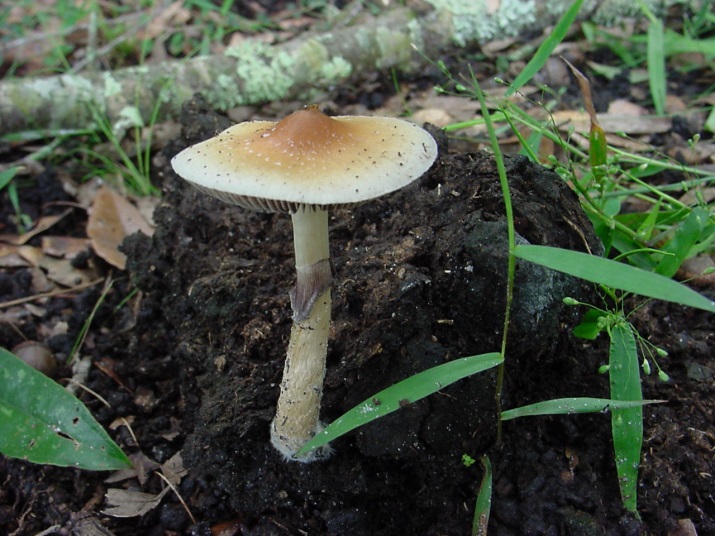
“Psilocybin cubensis mushroom” by Kristie’s Natures Portraits (CC BY 2.0)
Neuropsychopharmacologist Alexander Shulgin wrote about psilocybin mushrooms and their effects in his book TiHKAL [Tryptamines I Have Known And Loved]: The Continuation. From chapter 5 of TiKHAL titled ‘Shrooms:
“First effects felt at 10 minutes after eating the little devils. Shortly after that, the world erupted into patterns. Patterns over everything. They seemed to fill all the space between me and my surroundings. The most prevalent design was that of a sort of squarish amoeba with a central black dot, like a nucleus, repeated endlessly and in three dimensions. Actually, it began to look most of all like chickenwire, with a small black dot in the middle of each square. In three dimensions.”
While psychedelic mushrooms have not been commonly implicated in fatality due to overdose and resulting toxicity, they have been associated with behavioral effects and changes that have contributed to fatality such as driving under the influence traffic collisions, pedestrian-vehicle encounters, jumping from heights such as tall buildings and bridges, and other situations involving psychotic episodes and changes in the overall state of consciousness.
Both psilocybin and psilocin are considered to be Schedule I controlled substances in the USA, and this includes the chemicals and the actual mushrooms themselves. The amount of mushrooms seized and identified by the United States Drug Enforcement Administration (DEA) has been relatively steady over the last 20 years, but the most recent seized evidence data from 2020-2022 shows an upward trend in positive identifications. A Drug Snapshot published by the DEA in 03/2025 shows that psilocin/psilocybin made up 93.9% (431 positive identifications) of psychedelic drug evidence during 10/01/2024-12/31/2024.
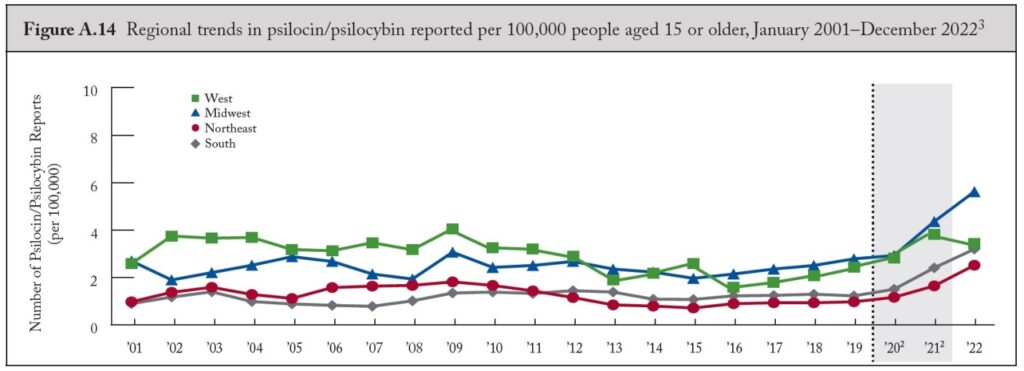
National Forensic Laboratory Information System. DEA Annual Drug Report (2022).
Psilocybin has been the subject of research in academia and industry for the last several decades for its potential use in treatment of personality and mood disorders, obsessive-compulsive disorder, anxiety, nicotine and alcohol dependence, and cluster headaches. In 2018, the substance was named a breakthrough therapy for use in treatment-resistant depression. It has been decriminalized or even legalized for possession and use in certain locations in the USA at a state or city level.
Axis Forensic Toxicology added testing for psilocybin (as psilocin) to the Comprehensive Panel, Blood (order code 70510) in 2024. Reporting limit for the compound was 5 ng/mL and it was reported as qualitative only. More recently, Axis has developed and validated a directed analyses for psilocin in urine (qualitative, reporting limit 5 ng/mL) and blood (quantitative, reporting limited 1 ng/mL) and other matrices utilizing liquid chromatography with triple quadrupole mass spectrometry (LC-MS/MS). It is important to note that psilocin’s stability in biological matrix is pH and light dependent. Please collect in a vial containing a preservative such as sodium fluoride, protect from exposure to light, and store in refrigerated conditions (2-8°C).
As always, if you have questions about psilocin and how it may play a role in your medical-legal investigation, please reach out to our subject matter experts by email ([email protected]) or phone (317-759-4869, Option 3).
References
- Baselt, R. Psilocybin. Disposition of Toxic Drugs and Chemicals in Man. Twelfth Edition. Biomedical Publications: Seal Beach, CA. Pages 1795-1796. (2020)
- Levine, B. Hallucinogens and Psychedelics. Principles of Forensic Toxicology. Fifth Edition. Pages 467-489. AACC, Inc. (2020)
- Shulgin, A. and Shulgin, A. TiHKAL, The Continuation. Transform Press, Page 112. (1997)
- National Forensic Laboratory Information System. Annual Drug Report. (2022).
- National Forensic Laboratory Information System. Drug Snapshot. (December 2024).