By Kevin Shanks, D-ABFT-FT
It has been a little over 4 years since Axis mentioned synthetic cannabinoids on this blog. So, briefly, synthetic cannabinoids are man-made compounds that bind to cannabinoid receptors 1 (CB1) and 2 (CB2) in the body and mediate effects of the endocannabinoid receptor system. While delta-9-tetrahydrocannabinol (THC), the main psychoactive cannabinoid found in cannabis, is a partial agonist of the cannabinoid receptors, most synthetic cannabinoids are full agonists at the same receptors. Synthetic cannabinoids are comprised of many structural variants, which change over time as compounds are controlled by Federal and state governments. Synthetic cannabinoids have been implicated in several outbreaks of illnesses and hospitalizations in the USA as well as associated with cause of death in postmortem toxicology.

Chemical Structure of 5F-ADB Drawn by Kevin G. Shanks (2025)
Methyl-2-[1-(5-fluoropentyl)-1H-indazole-3-carboxamido]-3,3-dimethylbutanoate, also known as 5F-ADB or 5F-MDMB-PINACA, is a potent synthetic cannabinoid compound that first emerged in Japan in late 2014 when it was identified on plant material products. Synthetic cannabinoids are commonly sprayed on plant material or soaked into small pieces of paper. 5F-ADB’s molecular formula is C20H28FN3O3 and its molecular weight is 377.4 g/mol. 5F-ADB is of the indazole-3-carboxamide family of compounds and consists of an indazole core structure, a fluorinated pentyl chain, and a carboxamide linking group. Common adverse effects after consumption of the substance include psychomotor agitation, tachycardia, confusion, anxiety, and loss of consciousness, psychosis, and fatality.
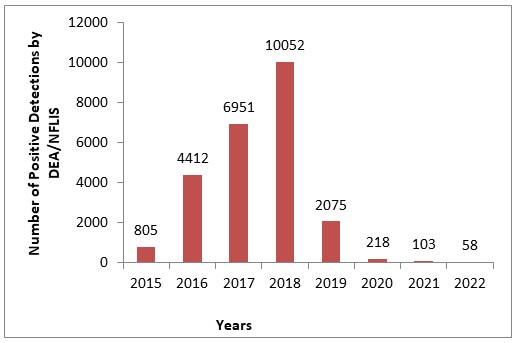
5F-ADB Detections by US DEA Reported in NFLIS Annual Drug Reports (2015-2022)
The drug was first reported by the United States Drug Enforcement Administration (DEA) in 2014 and emerged in toxicology testing in 2015. It was made a Schedule I controlled substance in the USA in 2017. After emergence, 5F-ADB hit peak prevalence in 2018 and then rapidly disappeared from the illicit drug market with just a handful of reports by the DEA by 2022. During 2021-2022, Axis Forensic Toxicology had zero detections of 5F-ADB in postmortem toxicology testing. Because of the combined DEA and Axis data, the lab decided to remove it from the scope of synthetic cannabinoid testing in 2022.
Until recently, the compound was considered to be non-existent on the street, but new reports suggest 5F-ADB has made a comeback as one of the top synthetic cannabinoids of choice in the USA. Published reports from NPS Discovery and the Center for Forensic Science Research and Education (CFSRE) in 2025 detail 5F-ADB’s comeback as either the first or second most identified synthetic cannabinoid in cases sent to them. Axis Forensic Toxicology has also spoken to pathologists who have had positive casework for 5F-ADB, over the last few months, especially in the prison population. Because of these recent events, the lab has added 5F-ADB back into the screening scope of analysis in the comprehensive panel (order code 70510). 5F-ADB is rapidly metabolized/degraded to its 3,3-dimethylbutanoic acid metabolite by enzymes in the blood and therefore must be analyzed by monitoring the metabolic product. The reporting limit for 5F-ADB 3,3-dimethylbutanoic acid on the screening test is 2 ng/mL. The result is reported as qualitative. Instrumentation used for analysis is liquid chromatography with quadrupole time of flight mass spectrometry (LC-qToF-MS). Upon publication of this blog post, Axis has had recent detections of 5F-ADB via its metabolite in 5 different states – Florida, Indiana, Missouri, Ohio, and South Dakota.
It is important to remember that while most novel psychoactive substances emerge and then disappear rapidly from the illicit market, some persist for months and years. And in the case of 5F-ADB, it emerged, peaked, rapidly disappeared, and now has made a resurgence years later. As a toxicology laboratory, it is prudent to monitor the ever-changing scope of the drug market and adapt testing panels accordingly. The current scope of testing offered by Axis Forensic Toxicology can be found in the online test catalog at https://axisfortox.com. As always, if you have questions about 5F-ADB or any other synthetic cannabinoid substances and how they may play a role in your medical-legal investigation, please reach out to our subject matter experts by email ([email protected]) or phone (317-759-4869, Option 3).
References
- Synthetic Cannabinoids. Disposition of Toxic Drugs and Chemicals in Man. Twelfth Edition. Randall C. Baselt. Biomedical Publications. Pages 1979-1986. (2020).
- Tetrahydrocannabinol. Disposition of Toxic Drugs and Chemicals in Man. Twelfth Edition. Randall C. Baselt. Biomedical Publications. Pages 2041-2045. (2020).
- Synthetic Cannabinoid Receptor Agonists. Novel Psychoactive Substances: Classification, Pharmacology, and Toxicology. Paul Dargan and David Wood. Academic Press (Elsevier). 317-338. (2013).
- NPS Discovery and CFSRE Trend Reports, Q1-Q3, 2025.
- Axis Forensic Toxicology. Laboratory Data. Indianapolis, IN. (accessed October 2025).