
In October, two of Axis’ toxicologists presented at the 2026 meeting of the National Association of Medical Examiners. The following is a summary of those presentations. Axis staff appreciate the opportunity to engage with clients in different ways at conferences and are very excited about opportunities to collaborate with clients on presentations.
When Femoral Blood is the Wrong Specimen
Kevin Shanks collaborated on a poster presentation with Dr. Elizabeth Pattison and Dr. Patrick Hansma of Western Michigan University Homer Stryker MD School of Medicine regarding the analysis of postmortem blood via different sources of collection. The poster centered on the death of a 45 year old male who was found deceased in his home. He was kneeling over, face down in his child’s bedroom. There was no significant past medical history documented, but recent events in his life led investigators to suspect suicide as a manner of death. At autopsy, the medical examiner found multiple fentanyl patches on his body. This included 7 25 mcg patches and 1 12.5 mcg patch on his chest and 3 25 mcg patches on his upper back. His heart weighed 490 grams. Focal moderate coronary atherosclerosis and mild pulmonary edema were also observed. Toxicological analysis was performed and femoral blood was positive for oxycodone, clonazepam, and ethanol. It was negative for fentanyl. Seeing this negative result for fentanyl, the iliac blood and subclavian blood were directed for fentanyl analysis. The iliac blood was positive for fentanyl (4.5 ng/mL) and the subclavian blood was positive for fentanyl (14.9 ng/mL). The medical examiner ruled that the death was fentanyl toxicity, but the discrepant results for fentanyl between blood sources may have resulted from the following potential mechanisms: the death occurred quickly after patch placement and fentanyl was not able to distribute to the lower extremities or the toxicological results may represent a postmortem diffusion of fentanyl down a concentration gradient. In conclusion, while femoral blood is the recommended specimen for postmortem toxicological analyses, it may not always be the best specimen. Case circumstances and context are always key. Collecting blood specimens from multiple sites in the body may help to resolve any concentration discrepancies.
BTMPS Update
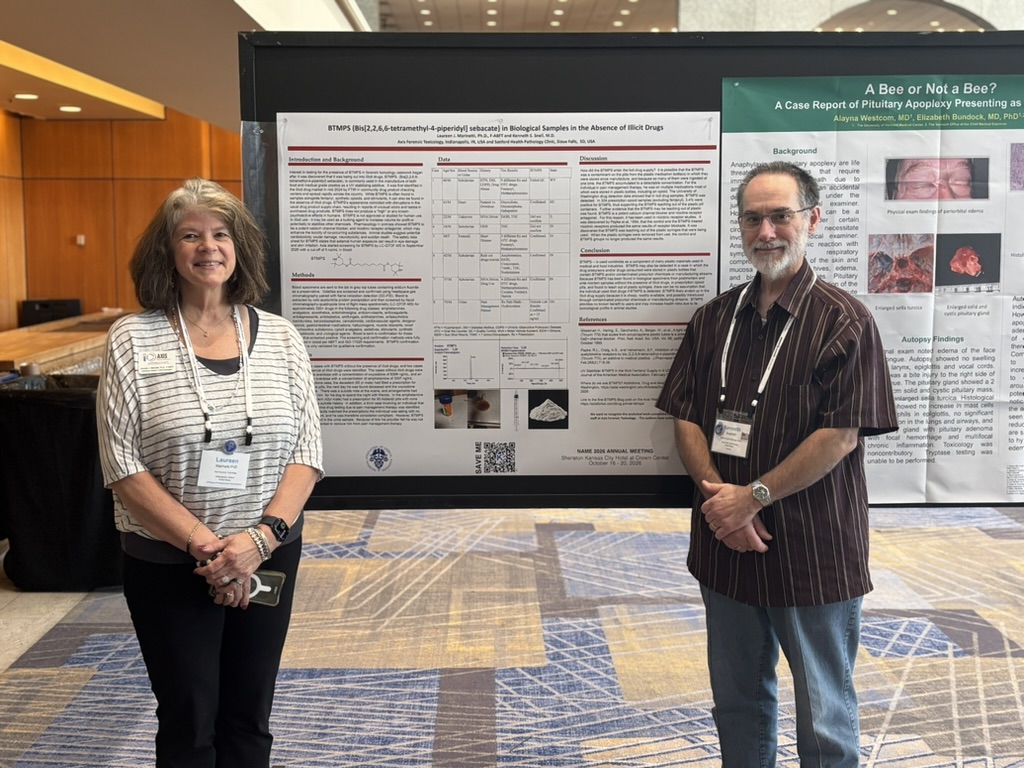
Dr. Marinetti and Dr. Snell
Dr. Marinetti and Dr. Snell, Forensic Pathologist from Minnehaha County Coroner, Sanford Health Pathology Clinic, Sioux Falls, SD, presented an updated version on BTMPS, (Bis[2,2,6,6-tetramethyl-4-piperidyl] sebacate), brand name Tinuvin®770, at the 2026 National Association of Medical Examiners (NAME) annual meeting in Kansas City, MO. Dr. Snell had Axis’s first BTMPS case without illicit drugs in this study. For the history, background and case work involving BTMPS please refer to the three previous Axis blog posts on BTMPS – links are in the references included here.
As previously stated, Axis has identified four confirmed positive postmortem cases with BTMPS, two without the presence of illicit drugs, and two cases with the presence of illicit drugs. One antemortem clinical case was brought to Axis’s attention as well.
Because BTMPS has been found in biological specimens from postmortem and antemortem samples without the presence of illicit drugs, in prescription opioid pills, and found to leach out of plastic syringes, there can be no assumption that the individual used illicit drugs if BTMPS is confirmed. In addition, through questions and comments after the presentations, some clinical labs have stopped testing for BTMPS because of its detection in samples without illicit drugs leading to the possibility of incorrect results interpretation. This is also true for postmortem case work; a decedent cannot be labelled as an illicit drug user just by the presence of BTMPS alone.
References for BTMPS
- Glossman H., Hering, S., Savchenko, A., Berger, W., et.al., A light stabilizer (Tinuvin 770) that elutes from polypropylene plastic tubes is a potent L-type Ca2+-channel blocker. Proc. Natl. Acad. Sci. USA, Vol. 90, pp9523-9527, October 1993.
- Papke, R.L., Craig, A.G., and Heinemann, S.F., Inhibition of nicotinic acetylcholine receptors by bis (2,2,6,6-tetramethyl-4-piperidinyl) sebacate (Tinuvin 770), an additive to medical plastics. J.Pharmacol Exp Ther. 1994 Feb;268(2):718-26.
- UV Stabilizer BTMPS in the Illicit Fentanyl Supply in 9 US Locations, Letter, Journal of the American Medical Association, February 5, 2025.
- Where do we see BTMPS? Addictions, Drug and Alcohol Institute, University of Washington, https://adai.washington.edu/WAdata/DrugChecking/BTMPS.html, 2026.
- First two BTMPS Blog posts on the Axis Website, Feb 6, 2026 https://axisfortox.com/drug-primer-btmps/ and June 2, 2026 https://axisfortox.com/matt-2026-recap-btmps/
If you have any questions or concerns regarding specimen selection, the role of BTMPS or any other new or old substance in your investigation, please reach out to our Axis Forensic Toxicology subject matter experts at [email protected] or by phone (317-759-4869, Option 3). To stay current with the scope of testing for all services offered by Axis, please consult the online catalog at https://Axisfortox.com.